How do you know if a decision was good or just lucky?
Judge a decision by how it was made, not by how it turned out. A single result mixes judgement and luck; the verdict belongs to the whole arc.
· 6 min read
Decisions · Fortune
If a decision worked out, you're tempted to call it a good one. If it went wrong, a bad one. Both are verdicts on the result, not on the decision. Judge a decision by how it was made, not by how it turned out: any single result is one frame of a longer story, and it mixes judgement and luck in proportions you can't see from where you stand. Good logic can lose by luck and bad logic can win by it, so the scoreboard alone can't tell you which one you had. Ask whether the decision was sound with what you knew at the time, and leave the verdict on the outcome to the whole arc, because fortune is still running.
You probably have one in mind already. The job you took that worked out, the move everyone congratulated you on — and the small voice asking whether you earned it or just got lucky. Or the careful choice that went wrong, which you keep reopening long after it closed. Both feel like verdicts. Neither is one yet.
The story: Croesus and Solon
The story comes from Herodotus, and it may never have happened as told. It is still the right place to begin.
Around 560 BC, Croesus was the richest man in the world — king of Lydia, gold running through his rivers, tribute arriving from cities that answered to nobody else. By any visible measure, he had won.
Solon visited him: the Athenian lawmaker, old, unimpressed by tours of treasuries. Croesus gave him one anyway — the gold, the palace, the scale of things — then asked the question he'd already answered for himself. Who is the happiest man you've ever seen?
He expected his own name.
Solon named a soldier who died in battle, victorious, surrounded by his sons. Then two brothers who pulled their mother's cart to a festival when the oxen were late and died peacefully that night, having done something good. Croesus was insulted — rivers of gold, and Solon was naming nobodies. Solon told him: call no man happy until he is dead. Croesus dismissed him. What could an old lawmaker know about fortune that the gold didn't already say?
Twenty years later, Croesus was on a burning pyre. Cyrus of Persia had beaten him — the war went wrong in ways nobody predicted, including Croesus, who'd asked the Oracle at Delphi whether to attack, been told a great empire would fall, and heard exactly what he wanted to hear. The empire that fell was his own.
On the pyre, he called Solon's name three times. Cyrus asked why, heard the story, and had the fire put out. The man who understood fortune — even from the losing end of it — turned out to be worth more than the man who'd only accumulated it.
Call no man lucky until he is dead
It's easy to read Solon's line as pessimism — don't enjoy anything, brace for the worst. That's not it. He was making a technical point about time: you can't assess a position until the paths have finished playing out. Croesus at his peak was one frame of a longer film, and the frame looked like winning. But fortune was still running. The result hadn't been declared — it just looked like it had.
A frame is not an arc
A frame is a single moment judged on its own: one point on the curve, with no shape and no direction. An arc is the whole path judged end to end, by its shape rather than by its highest point.
Croesus surveying his gold was a good frame. The soldier Solon named had a good arc: his life held together as a complete, worthwhile whole, and it ended at a point that matched what it had been building. The two brothers too. Their last day didn't fix anything; it closed a story that already made sense. A good frame is not evidence of a good arc. You can only read the arc once it has finished.
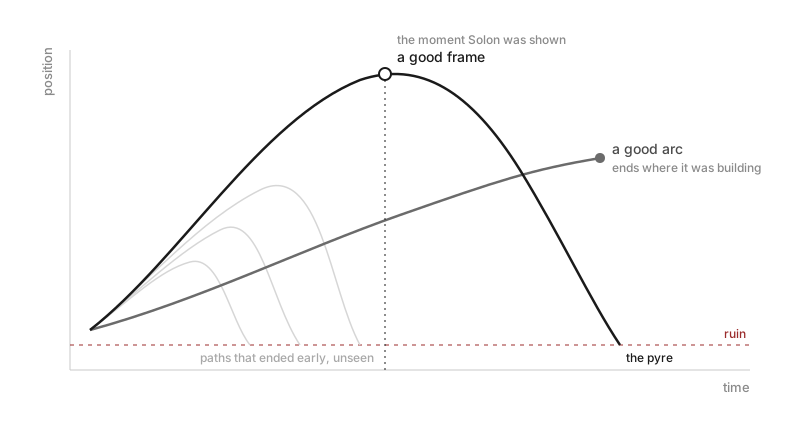
Every outcome you see is the surviving path
The surviving path is the one outcome you can see; the paths that ended earlier, with the same moves, stay invisible. You don't see the versions of Croesus who invaded Persia and lost earlier, the ones who never made the history books because their story ended before the tour. You don't see the parallel version of your own good call that went the other way on a different roll. This is what distorts how fortune gets read — we credit skill and character to people who mostly just survived to the peak, using the same moves as the ones who didn't.
Why a result feels like a verdict
Part of it is older than any decision you've made. Most of us inherit a few rules about luck before we're old enough to question them: that we're the lucky ones and should be thankful, that good fortune has to be deserved, that enjoying it too openly might make it leave. Nobody chose these rules. They come with being human and being raised by people who were raised the same way. But they turn every result into a moral score. A good outcome becomes proof you deserved it; a bad one, proof you didn't. That's why the scoreboard feels like a verdict, even when it's mostly fortune.
Three ways to judge a decision instead of its result
Position isn't outcome. Being at the peak means you're well positioned, not that the game is over. The work that got you there isn't the work that keeps you there.
Judge the decision, not the result. Bad logic can win by luck, good logic can lose by it, and grading yourself on the scoreboard alone is how a surviving path gets mistaken for a correct one.
The unit that matters is the whole arc. Not the quarter, not the peak, not how today feels. Croesus was fragile at the top; the soldier died at the right moment, having done something worth doing. One was a good frame. The other was a good arc.
The question to ask
Fortune doesn't care about your current score. It's still running.
What are you calling a good decision right now — because it worked, or because it was actually sound?